
What Is Marketing and What Is It For?
Marketing is not just advertising, bright banners, or daily social media posts. It is the system that helps a business understand the market, choose the right audience, explain the value of its offer, and move people toward a decision without guessing.
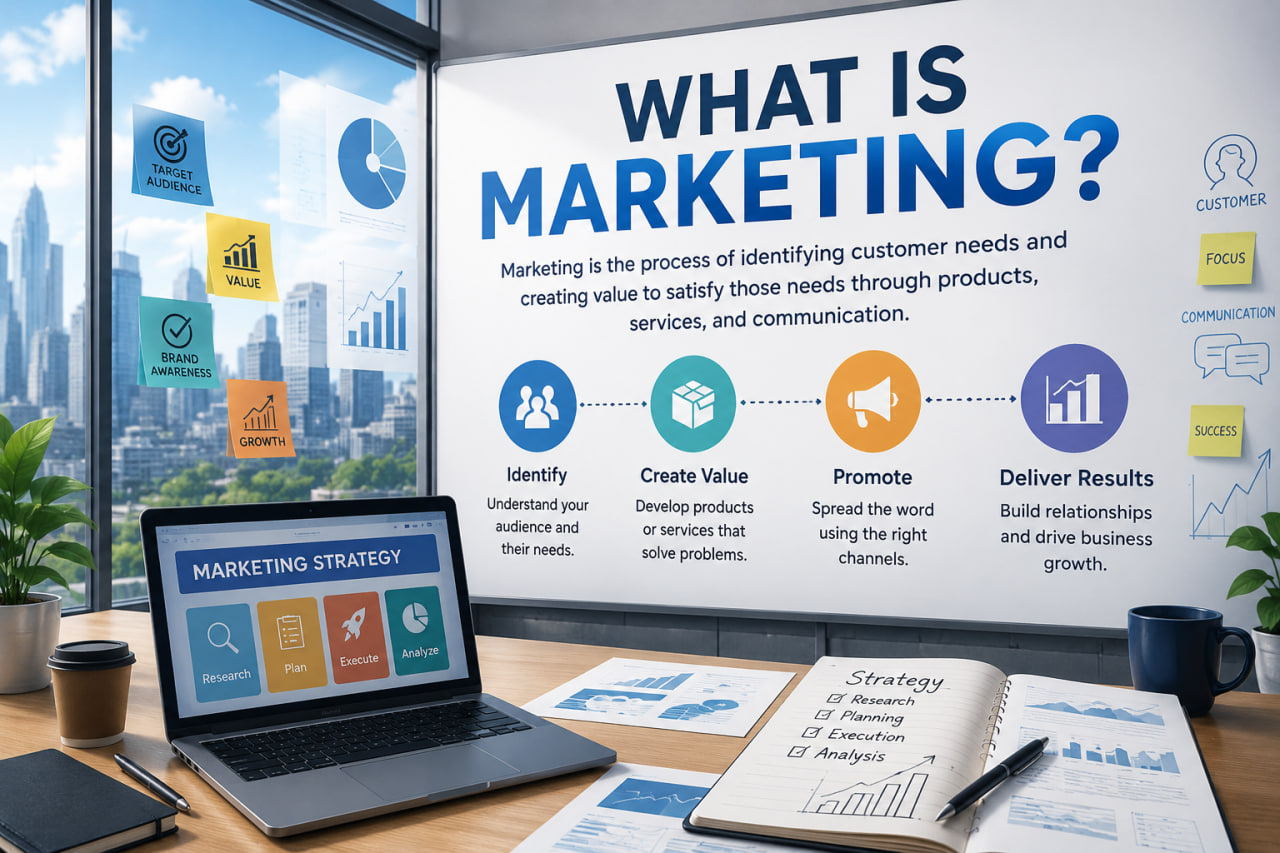
In simple words, marketing answers the questions every serious business must face. Who are we selling to? Why do these people need the product? What makes the offer different? Where should customers see us? What should convince them to take the next step?
Without those answers, a company can spend money and still not understand what actually works. Marketing gives direction. It connects product, audience, message, trust, traffic, sales, and customer retention into one system.
That is why marketing is a foundation. A business can have a good product, a serious team, and a clean website. But if the market does not understand why it should care, growth becomes random.
What Is Marketing?
Marketing is the process of creating, communicating, delivering, and improving value for a specific audience. It starts before the first ad is launched. It begins with research: who the customer is, what they need, what they already believe, and what blocks them from buying.
Good marketing is not noise. It is organized communication. It helps a business say the right thing to the right person, through the right channel, at the right moment.
What Is Marketing For?
Marketing exists to connect a product with people who can benefit from it. Not vaguely. Practically. Through need, positioning, offer, channel, proof, and timing.
When marketing works correctly, a company does not only see traffic or followers. It sees the full customer journey: first contact, interest, comparison, trust, purchase, repeat order, and referral.
Customer UnderstandingMarketing shows who the audience is, what they care about, what they compare, and which arguments can move them closer to a decision. |
Demand GrowthA product can stay invisible without demand. Marketing creates attention, warms the audience, and makes the value of the offer easier to see. |
Brand TrustPeople buy more confidently when they understand the company, see its expertise, and feel that the offer is clear, real, and reliable. |
Sales DirectionMarketing builds the path from awareness to lead, consultation, purchase, repeat contact, and long-term customer value. |
How Marketing Helps a Business
Strong marketing removes uncertainty. The business stops guessing and starts making decisions based on market signals, customer behavior, traffic sources, sales data, and campaign results.
It does more than bring new customers. Marketing improves the product package, sharpens the offer, supports sales teams, and shows which audience segments bring the most value.
- It helps the business stand out. When many offers look similar, marketing explains why one product deserves attention.
- It reduces wasted budget. Before scaling a campaign, a company can test messages, audiences, landing pages, and channels.
- It supports sales. Sales becomes easier when the brand is clear, the website answers questions, and the customer already understands the value.
- It creates long-term value. Advertising can bring quick traffic. Marketing builds a system that can keep working after one campaign ends.
Why Business Struggles Without Marketing
Without marketing, a business often depends on chance. Someone recommends it. Someone notices a sign. Someone finds the site by accident. Those things can bring individual sales, but they do not create a stable growth engine.
The market moves quickly. Competitors improve websites, publish content, collect reviews, run ads, build funnels, and study analytics. A company that ignores marketing slowly loses attention, even when its product is good.
Marketing is not only for large brands. Small businesses often need it even more because every lead, every channel, and every dollar matters.
Basic Marketing Terms Explained
You do not need to start with complicated frameworks. First, understand the basic terms. They explain how promotion works and why some businesses grow while others stay unnoticed.
| Term | What It Means | Why It Matters |
|---|---|---|
| Target Audience | The group of people who are most likely to need your product or service. | It keeps the business from wasting resources on everyone. |
| Positioning | The way the market should understand your brand, product, or service. | It helps customers quickly see how you are different from competitors. |
| Value Proposition | The clear reason why a customer should choose your offer. | It makes the offer specific instead of looking like every other option. |
| Lead | A potential customer who has shown interest by calling, messaging, subscribing, or leaving a request. | It helps sales teams focus on people who already have some intent. |
| Conversion | The percentage of people who complete a desired action, such as clicking, requesting, or buying. | It shows whether a page, ad, or offer is actually working. |
| Sales Funnel | The path from first contact to purchase and repeat interaction. | It shows where people drop off and what needs to be improved. |
| Brand | The image of the company in the customer’s mind: trust, style, promise, and experience. | It helps a business be remembered and chosen for more than the lowest price. |
What Marketing Includes
Marketing is not one tool. It is a combination of research, strategy, product packaging, content, advertising, analytics, sales support, and customer experience. When one part is missing, the system becomes weaker.
You can launch ads and receive traffic. But if the website does not explain the benefits, leads will be weak. You can collect many leads, but if the offer does not match the customer’s need, sales will be low. Marketing has to be viewed as a connected system.
- Market research: analysis of customers, competitors, demand, and barriers to purchase.
- Strategy: choice of audience, goals, channels, and core messages.
- Product packaging: offer, benefits, visual style, page structure, and proof.
- Promotion: SEO, PPC, social media, email, content, partnerships, and PR.
- Analytics: tracking leads, sales, conversions, customer cost, and channel efficiency.
- Retention: repeat purchases, loyalty, reviews, customer communication, and referrals.
Marketing Is Not Only Advertising
Advertising is a part of marketing, but it does not replace it. Advertising brings attention. Marketing explains who should receive that attention, what message they should see, why it matters, and how the business should turn interest into action.
Without strategy, advertising becomes a list of expenses. Without analytics, it is hard to know which channels bring profit. Without positioning, the audience sees just another company with no clear reason to remember it.
That is why marketing begins before a campaign starts. It begins with understanding the customer and does not end at the purchase. It continues through the experience after the sale.
Need a Clear Marketing System?
Start with the basics: define your audience, shape your value proposition, review your website, choose acquisition channels, and measure results. Marketing works better when every step is connected to a business goal.
Discuss MarketingFAQ
What is marketing in simple words?
Marketing is a system that helps a business understand customers, create a valuable offer, communicate it clearly, and turn interest into sales.
What is marketing for?
Marketing is used to attract customers, build trust, increase sales, understand the market, and create stable demand for a product or service.
Why is marketing called the foundation of business?
Because it connects product, customer, brand, sales, and communication. Without that foundation, it is difficult for a business to grow consistently and compete.
How is marketing different from advertising?
Advertising is one promotion tool. Marketing is broader: it includes audience research, strategy, positioning, product packaging, channels, analytics, and customer retention.
How does marketing help small businesses?
It helps small businesses spend budget more carefully, understand customers better, stand out from competitors, and get more qualified inquiries from available channels.
Final Thoughts
Marketing is not something a business does “for appearance.” It helps a company speak to the market in a language people understand, see real customer needs, and build sales through a system rather than luck.
Without marketing, a company can be good but invisible. With marketing, it gets direction: who to sell to, what to promise, how to prove value, and where to look for growth.