
What Is Local SEO and Why It Matters
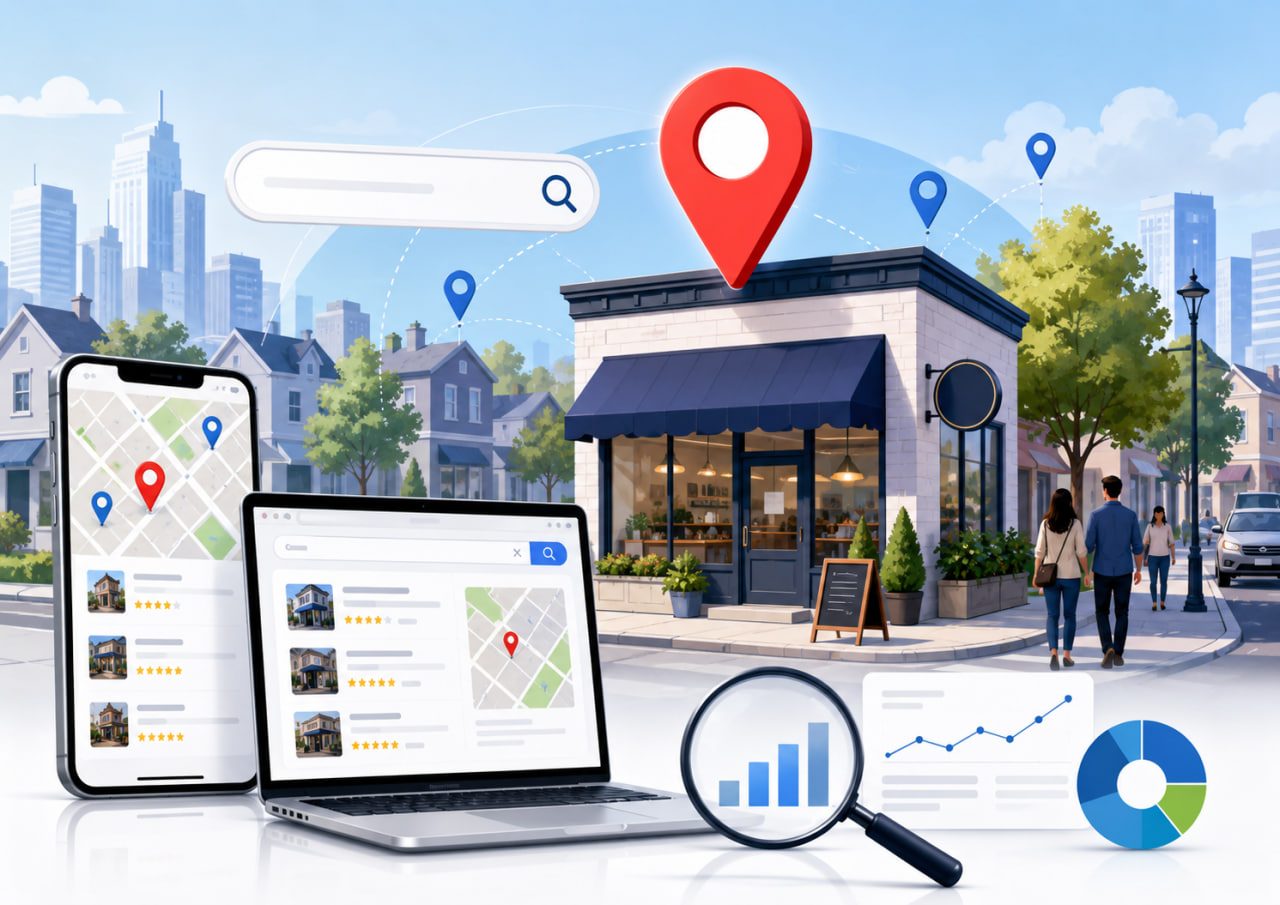
Local SEO is the process of making a business visible when a person searches with local intent: a city, a neighborhood, “near me,” “open now,” or a service plus location. It matters because these searches are not casual reading. They usually happen when someone is choosing where to go, who to call, or which company to trust.
What local SEO really means
Local SEO is not only a Google Business Profile and it is not only a page with a city name. It is the connection between your business information, website content, reviews, location signals, internal links, and the user’s intent. A strong local setup answers three questions clearly: what do you offer, where do you offer it, and why should a nearby customer pick you instead of another result?
Map visibility
Your profile, categories, services, photos, hours, and reviews help people compare you before they even open the site.
Local landing pages
Pages explain the service in a specific area with real details, not copied text with a changed city name.
Trust signals
Consistent contact details, reviews, useful FAQs, and clear next steps reduce doubt before a call or booking.
Practical priority model
Local SEO value distribution
This is a practical working model for building a useful local page and profile. The percentages show where effort usually creates the most business value, not a fixed Google formula.
Core elements to build
| Element | What it should do | What weak pages usually miss |
|---|---|---|
| Google Business Profile | Show correct services, categories, hours, photos, service area, and contact actions. | Wrong category, old hours, no services, no photos, and no posts or updates. |
| Service page | Explain one offer clearly: problem, process, result, who it is for, and how to start. | Generic text that talks about “quality service” without saying anything useful. |
| Location page | Connect the service to a real area with coverage details, local examples, and FAQs. | Doorway-style pages where only the city name changes. |
| Reviews | Prove that real customers have used the business and received a result. | No review strategy, no replies, or only old feedback from years ago. |
| Internal links | Move users from educational content to service and location pages naturally. | Blog posts that get traffic but never lead visitors to a business action. |
Why it matters for business
Broad SEO can bring readers from anywhere. Local SEO focuses on people who can actually buy from you. A visitor searching “marketing agency” may only be researching. A visitor searching “local SEO agency near me” or “SEO help for local business in Chicago” is closer to comparison and action.
That is why local pages should be written for decisions, not just rankings. Explain pricing factors, service areas, response times, what happens after the first contact, and the difference between basic help and a deeper campaign. Useful detail keeps the page from feeling like a template.
Simple rule: if a customer could ask it on a phone call, it probably belongs on the page. Location, timing, process, proof, limits, and next steps are not “extra content” — they are conversion content.
Checklist for a stronger local page
| Priority | Action | Business benefit |
|---|---|---|
| High | Match the page to one clear local intent, not five mixed services. | Better relevance and easier reading. |
| High | Add service area details, contact options, proof, and FAQs. | Less uncertainty before the visitor calls or books. |
| Medium | Link from blog articles to the most relevant service pages. | Traffic has somewhere useful to go next. |
| Medium | Keep business name, address, phone, and hours consistent. | Cleaner trust signals across search and maps. |
| Ongoing | Collect reviews and update the page when services or locations change. | Fresher signals and stronger customer confidence. |
Common mistakes
The most common mistakes are thin city pages, fake local wording, missing phone numbers, ignoring reviews, hiding service areas, and writing content that sounds like every competitor. Local SEO works when the page helps a real person choose. If it only repeats “best local service” in different sentences, it is not doing enough.
Bottom line
Local SEO matters because it turns search visibility into real calls, visits, forms, bookings, and conversations. When the profile, reviews, pages, and internal links support each other, the business becomes easier to discover and easier to trust.